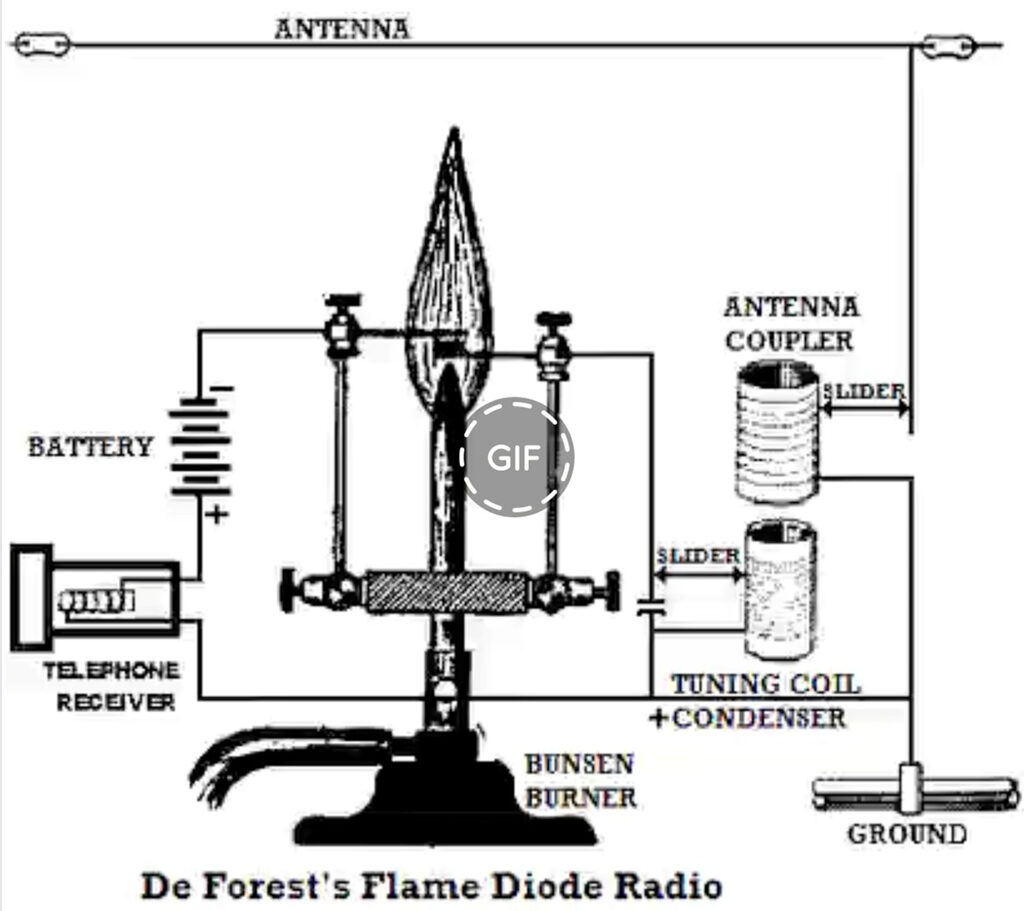
The De Forest Flame Diode
Around 1903, Dr. Lee De Forest invented and experimented with a flame diode. De Forest was rather impressed with the performance of the flame diode as a radio detector , but he realized it had no real practical application. On the other hand, De Forest claimed that he got the idea for his audion tube (1906) while he was experimenting with ionized gases in a flame acting as a radio detector. In this respect the flame diode was a precursor to the audion tube which was a precursor to the triode tube which was a precursor to the multi-element tubes which made modern electronics possible.
The flame diode consists of a metal cup that holds a small amount of an hydroxide of an alkaline metal (like lye [sodium hydroxide]) and a wire above the cup. Both elements are put inside a Bunsen burner flame and the cup is heated to red hot to liberate positive ions from the hydroxide. The negative wire above the cup attracts these ions and a current flows. If there is a radio signal present, the current will vary with the radio’s signal and sound will be heard in the telephone receiver.
The diode thus created is actually quite sensitive at detecting radio signals , but every little variation or tiny flicker in the flame causes a loud noise in the telephone receiver. Because it is so difficult to produce a steady flame plus the fact that an open flame is dangerous , De Forest considered the flame diode detector unsuitable for any kind of commercial application. However, a few early experimenters built them for home and laboratory use and people over 100 years later are still playing around with them.
An effective radio detector, but it requires an absolutely steady flame.
The original design calls for a Bunsen burner because they may be adjusted to burn cleanly and quietly . The flame from a propane torch should work, but would probably be very noisy. The tuning and antenna portions of the radio are the same as a crystal or Fleming Valve radio, but with the battery and flame diode taking the place of the crystal or Fleming Valve. If you decide to build one, I’d appreciate it if you’d write me and tell me what kind of burner you are using and how well it works as a radio detector.
(Thanks to Mike Wegner – KI4TWB for sharing this information)